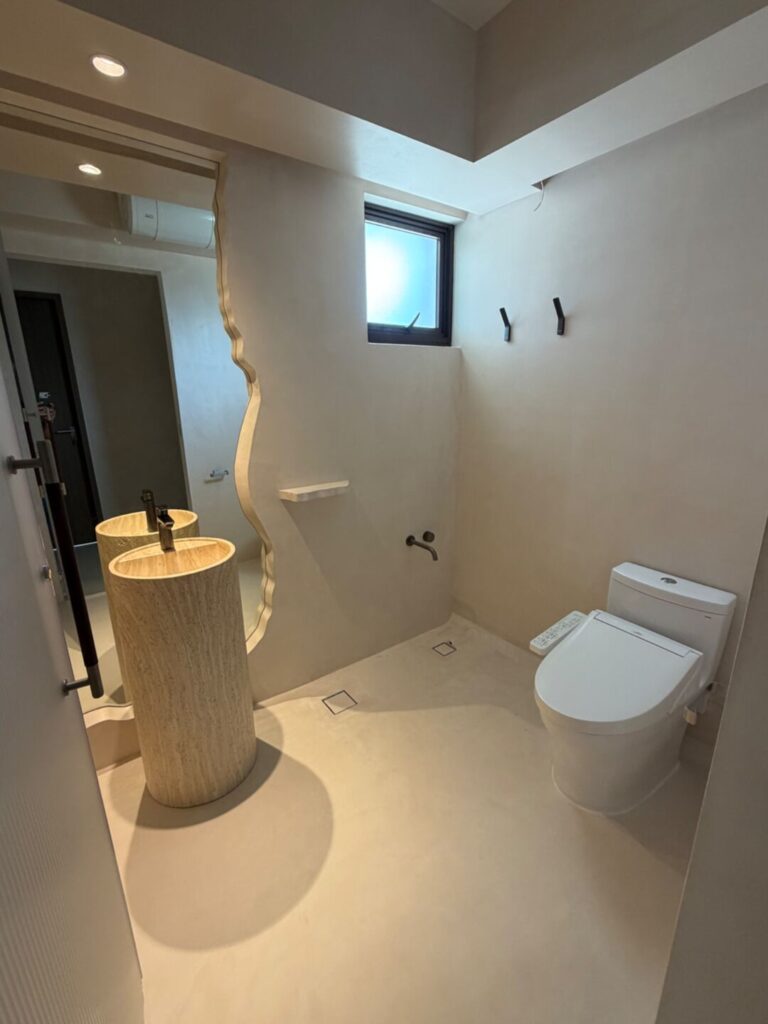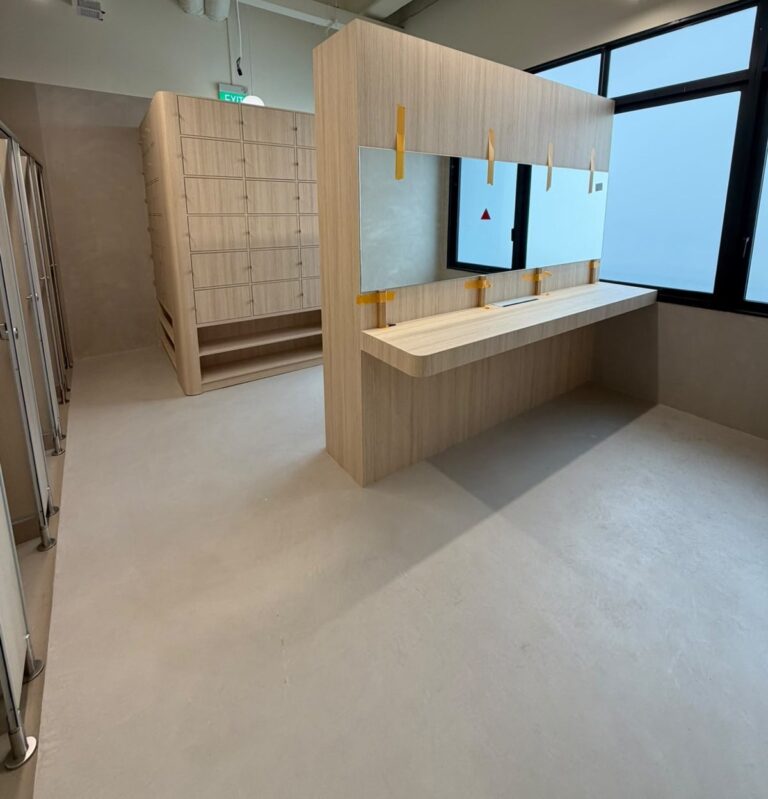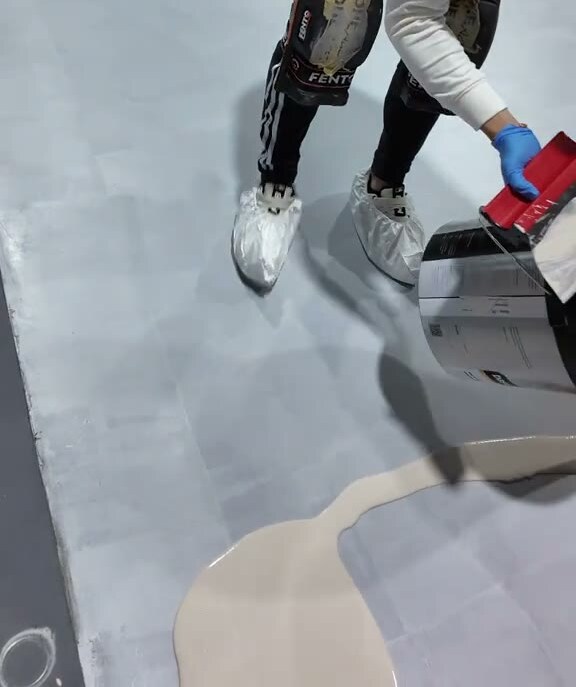
Yes. Microcement can be applied to staircases, covering treads and risers in the same continuous surface as the floor around them, with an anti-slip top coat where it is needed. It suits concrete stairs and sound existing tiled stairs, and it gives landed homes, maisonettes, shops and offices a clean, joint-free look. The two things to get right are the base underneath and the stair edges, which take the most wear.
Why microcement suits stairs
- One surface from floor to stair: the same finish runs up the steps with no grout lines and no change of material.
- No hacking of sound tiled stairs: at 1–1.5mm thick, it can go over sound, well-bonded tiles, so each step only rises by a millimetre or so.
- Clean edges: treads, risers and nosings can be finished as one piece, without separate edge trims.
Which staircases are suitable
- Concrete stairs: a good, stable base once cleaned and repaired.
- Tiled stairs: suitable if the tiles are sound and well bonded. Hollow or cracked tiles, or loose nosing tiles, must be fixed first.
- Timber stairs: more difficult. Timber moves and can flex underfoot, which can crack a thin hard layer, so it needs careful assessment and preparation, and is not always suitable.
- Metal or open-tread stairs: assess case by case, since flexing and vibration are a risk.
Hairline cracking comes from the substrate, not the product. If a stair moves, flexes or has hollow tiles, that has to be solved before any finish goes on. See does microcement crack over time.
Safety: grip on the treads
A smooth sealed finish can be slippery, especially with socks or wet feet. On stairs, ask for an anti-slip top coat on the treads, and decide early whether the stairs are indoor and dry, near a wet area, or outdoors, since each needs a different level of grip. Good lighting on the steps also helps, and is worth planning at the same time.
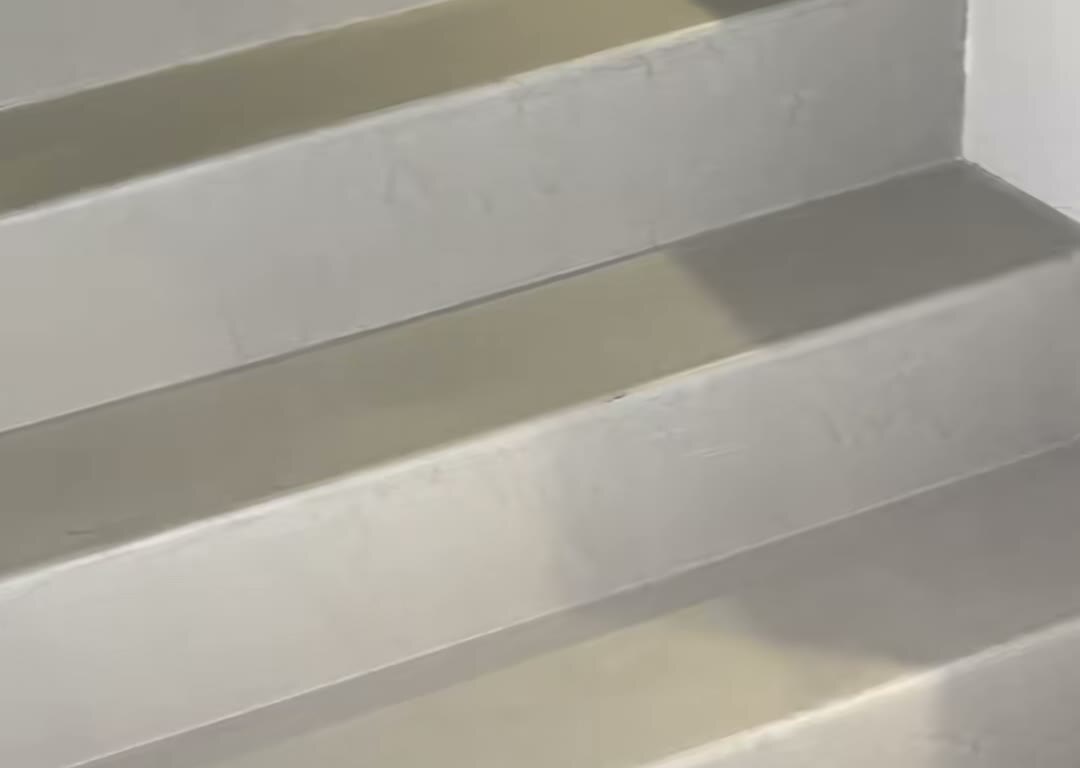
Edges and nosings
The front edge of each tread takes every footstep and most knocks. Ask how the applicator will form and reinforce the nosing, whether edges will be slightly rounded, and how chips can be repaired later. Sharp, thin edges chip more easily than slightly softened ones.
The process
- Survey the stairs and repair any loose or hollow tiles, cracks or damaged nosings.
- Prepare and clean the surface. Sound tiles are prepared and covered with no primer in our system.
- Apply four layers by hand: a base coat, a face coat and two top coats, with anti-slip added on the treads where needed.
- Keep the stairs closed while the layers set. If the stairs are your only route, plan an alternative or schedule the works when you are away.
Looking after microcement stairs
Vacuum or sweep grit often, since grit is what wears the treads. Mop with a pH-neutral cleaner, avoid bleach and abrasive pads, and wipe spills quickly. See how to clean and maintain microcement floors.
What affects the quote
Stairs take more detailed work per square metre than a flat floor, because every tread, riser and edge is finished by hand. The number of steps, the base material, the repairs needed, the finish and the anti-slip requirement all affect the price. We quote after seeing the stairs. See what drives the cost of microcement, and for the floor around the stairs, who to hire for microcement flooring.
Quick answers
Is a microcement staircase slippery?
A smooth sealed finish can be. On stairs, an anti-slip top coat is applied to the treads where needed, with more grip specified near wet areas or outdoors.
Can microcement go over tiled stairs?
Yes, if the tiles are sound and well bonded. Hollow, cracked or loose nosing tiles are repaired first, then microcement is laid over the top at 1 to 1.5mm.
Can microcement be used on timber stairs?
Sometimes, but timber moves and can flex, which can crack a thin hard layer. Timber stairs need a careful assessment, and some are not suitable.
Will the stair edges chip?
Edges take the most wear. Well-formed, slightly rounded nosings and a good top coat reduce chipping, and small chips can usually be repaired.
Next step
Send us a few photos of the stairs, the number of steps and what is on them now. WhatsApp +65 8049 1188 or use the contact page. Our Tampines showroom is open by appointment.